
If your lawn holds water for days after every rain, breeds mosquitoes in the low spots, and squishes underfoot well into the dry season, you have a drainage problem that will not solve itself. Two of the most common professional fixes are the French drain and the catch basin, and homeowners often ask which one they need. The honest answer is that they solve different problems, and the right choice, sometimes both together, depends entirely on what kind of water you are fighting. Here is how to tell them apart and match the solution to your yard.
Two different kinds of water problems
The key to choosing is understanding that standing water comes from two sources. There is surface water, the rain that runs across the top of your lawn and collects in a low spot or against a patio. And there is subsurface water, the moisture that saturates the soil itself and keeps the ground soggy from below. In Manalapan Township, East Brunswick, and much of Central New Jersey, our pockets of compacted clay make the subsurface problem especially stubborn, because clay holds water and refuses to drain. A solution aimed at the wrong type of water will disappoint you, no matter how well it is built.
What a catch basin does
A catch basin is a grated box set into a low point of your yard, connected to an underground pipe that carries the collected water to a safe discharge point. Think of it as a drain in the floor of your lawn. It is excellent at capturing surface water: the runoff that sheets across the yard and pools in a defined low area, the water that collects at the base of a slope, or the overflow from a downspout. When you have a clear spot where water gathers on the surface, a catch basin gives that water a fast exit.
Catch basin strengths and limits
- Best for a defined low spot where surface water visibly collects and ponds.
- Handles high volumes of runoff quickly through its grate and pipe.
- Requires a viable discharge point where the piped water can safely go.
- Does little for a whole yard that stays soggy from saturated soil, because it only captures water that reaches its grate.
- Grates need occasional clearing of leaves and debris to keep working.
What a French drain does
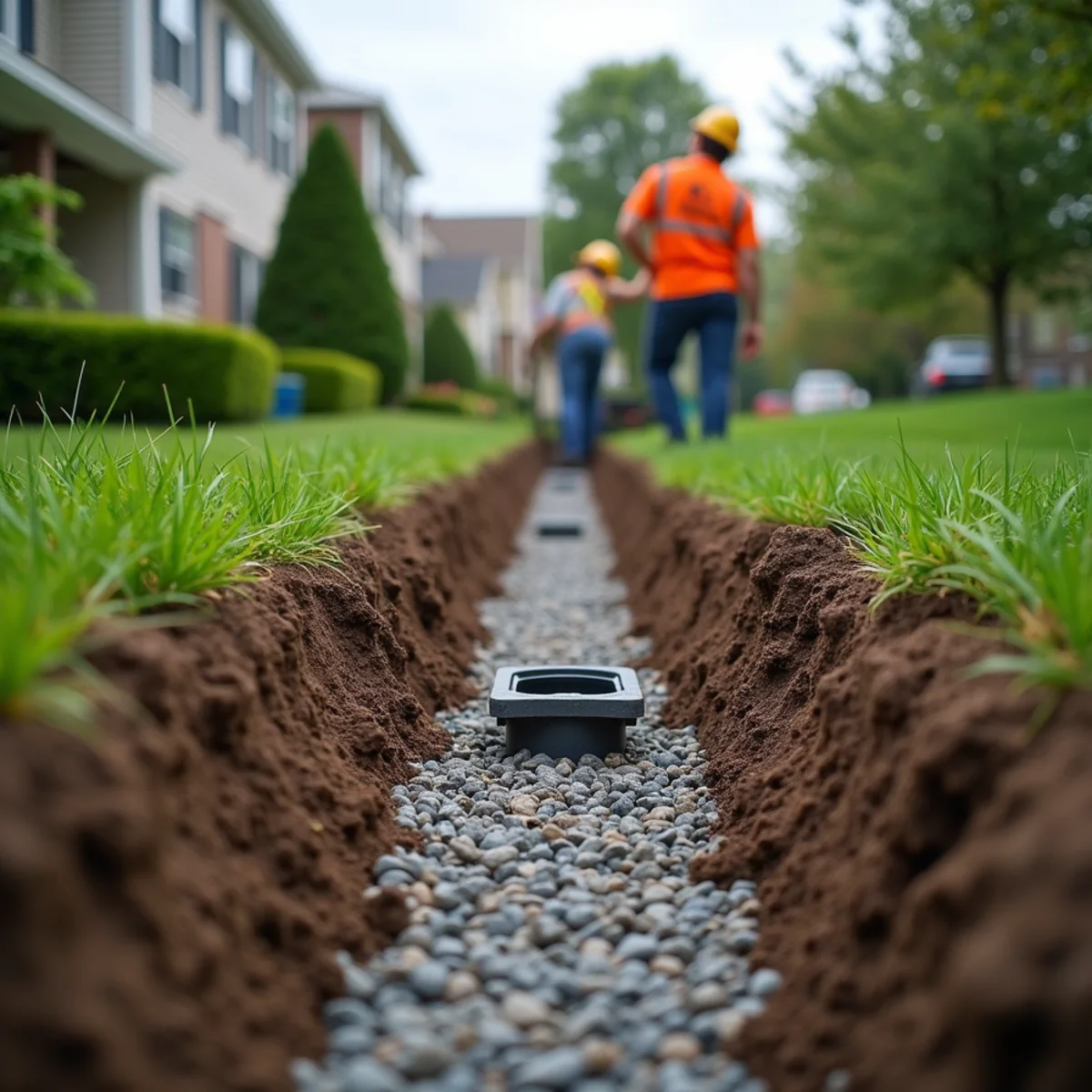
A French drain is a different tool for a different job. It is a gravel-filled trench containing a perforated pipe, wrapped in filter fabric, that intercepts water below the surface and carries it away. Rather than waiting for water to pool on top, a French drain pulls moisture out of the soil itself along its entire length. This makes it the right answer for a yard that stays saturated, a slope that seeps, water pushing against a foundation, or the broad soggy areas our clay soils are prone to. It addresses subsurface water that a catch basin would never see.
French drain strengths and limits
- Best for chronically saturated soil, seeping slopes, and water relief along a foundation.
- Intercepts water along its whole run, not just at one point.
- Well suited to our clay-heavy soils that hold subsurface moisture.
- Requires proper slope, the right stone and fabric, and a safe discharge to work long term.
- More involved to install correctly, but far more effective for widespread sogginess.
Which one does your yard need?
Start by watching your yard during and after a heavy rain. If water clearly runs across the surface and gathers in one obvious low spot, a catch basin tied to a good discharge point may be all you need. If instead the whole area, or a broad section, stays wet and spongy for days without an obvious pooling point, the problem is subsurface and a French drain is the better tool. Many properties, especially those with both a low spot and heavy clay, benefit from a combined system that captures surface water at a catch basin and relieves subsurface water with a French drain, all routed to the same safe outlet.
This is exactly the evaluation our French Drain and Yard Water Solutions service is built around. Rather than defaulting to one product, we read how water actually moves on your specific lot, identify whether you are fighting surface runoff, saturated soil, or both, and design the system to match. Getting this diagnosis right is what separates a drainage fix that lasts from one that disappoints.
When the water is an emergency
Sometimes drainage is not a slow annoyance but an active threat, with water pooling against a foundation during a storm or a yard flooding faster than it can drain. In those situations our Emergency Yard Drainage Mitigation service can respond to stabilize the immediate problem, and then we plan the permanent French drain or catch basin solution once the crisis passes. Chronic standing water rarely improves on its own; each wet season tends to deepen the low spots and further compact the soil.
If your lawn is fighting standing water, let us diagnose the real cause before you spend on the wrong fix. The Blue Sky One LLC has served Monmouth County since 2020, we are licensed and insured, and we design drainage around how Central Jersey soil actually behaves. Call (323) 606-0255 for an evaluation, backed by our satisfaction guarantee.
Ready to start? Talk to a local landscaping expert now.
(323) 606-0255Frequently Asked Questions
A catch basin is a grated box that collects surface water pooling in a low spot and pipes it away. A French drain is a gravel-filled trench with a perforated pipe that intercepts subsurface water saturating the soil along its whole length. The catch basin handles water on top; the French drain handles water in the ground. They solve different problems.
Watch your yard during heavy rain. If water runs across the surface and gathers in one clear low spot, a catch basin may suffice. If a broad area stays soggy and spongy for days without an obvious pool, the water is subsurface and a French drain is better. Many yards with both issues benefit from a combined system.
Central New Jersey has pockets of compacted clay that hold water and drain very slowly, so the ground stays saturated from below long after rain stops. This subsurface sogginess is exactly what a catch basin cannot fix, since it only captures water that reaches its grate. A French drain, which relieves water within the soil, is usually the better tool for clay.
A drain that works long term needs correct slope, proper stone and filter fabric, and a safe, legal discharge point. Done wrong, it clogs, collapses, or drains to nowhere, and improper discharge can push water onto a neighbor and cause disputes. Because diagnosis of surface versus subsurface water matters so much, a professional evaluation usually saves money over a failed DIY attempt.