
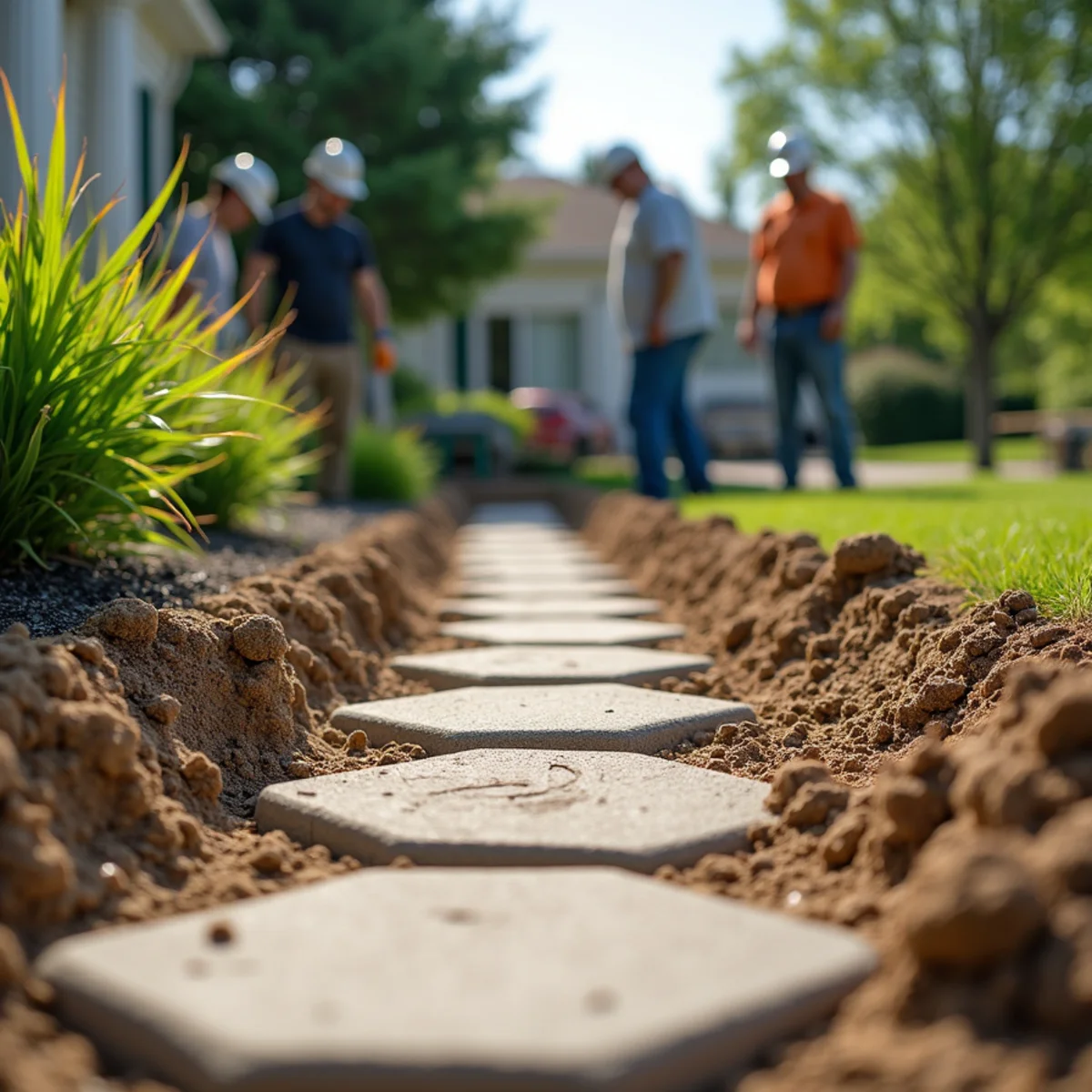
A paver patio or walkway that sinks in spots, rocks underfoot, or sprouts weeds between the joints is rarely a paver problem. It is almost always a base problem. The pavers you see are the last inch of a system that lives underground, and in Monmouth County that buried system has to survive freeze-thaw heaving, saturated clay, and 46 inches of rain a year. Getting the base right is the single biggest factor separating a walkway that lasts thirty years from one that fails in three.
Why pavers settle and weeds take over
Settling happens when the material beneath the pavers compresses unevenly or washes out. If a contractor lays pavers over unscreened native soil, over too little stone, or over a base that was never properly compacted, traffic and weather will find the weak spots. Water is the accelerant: it carries fines away, softens clay, and freezes into expanding ice lenses that lift and drop the surface every winter. Weeds are a related symptom. Seeds blow into open joints, and where jointing sand has washed out or organic debris has collected, they germinate and widen the gaps.
The anatomy of a base that lasts
A durable installation is a layered system, and each layer has a job. Skipping or shortcutting any one of them is where problems begin.
- Excavation to full depth, typically seven to twelve inches below the finished surface for a walkway and deeper for driveways
- A compacted subgrade with the correct slope for drainage, usually about one-eighth inch of fall per foot away from structures
- A geotextile fabric over clay-heavy subgrades to separate soil from stone and stop fines from migrating
- Four to six inches or more of dense-graded crushed stone, compacted in two-inch lifts
- A thin, screeded bedding layer of coarse sand or fine stone chips
- The pavers, set tight, with joints filled by polymeric sand
- A rigid edge restraint spiked into the base to lock the field in place
Compaction in lifts is non-negotiable
The most common corner cut is dumping the full base depth and compacting it once. A plate compactor only densifies the top few inches, so a six-inch pile compacted in a single pass stays loose underneath and settles later. We compact in two-inch lifts, running the plate compactor in overlapping passes over each layer, so the entire base reaches proper density. On our residential hardscape design projects around Spring Lake, this discipline is what keeps a patio dead level years after installation.
Why Central Jersey soil raises the stakes
Where the subgrade is sandy loam, it drains well but can lose fines if it is not separated from the base with fabric. Where it is the heavy clay common in pockets across the county, it holds water, softens, and heaves hard in freeze-thaw cycles. Both call for the same insurance: geotextile separation fabric and a thicker, well-compacted dense-graded aggregate base. On problem lots we also address where the water goes, because a patio built over ground that stays saturated will always fight you.
Edge restraint and jointing: the finishing details
Even a perfect base fails if the perimeter is not restrained. Without a rigid edge spiked into the compacted stone, the outer pavers creep outward, joints open, and the field unravels from the edges in. We install commercial-grade edge restraint on every job. For the joints, polymeric sand, swept in and activated with a light misting, hardens to resist washout and dramatically reduces weed growth and ant activity compared with plain sand. It is not permanent, so a joint refresh every several years is normal maintenance, not a failure.
Repair versus rebuild
If only a small area has settled and the rest is solid, a localized repair is possible: lift the affected pavers, correct the bedding and base beneath, and reset them. But if settling is widespread, the underlying base was likely undersized or poorly compacted, and spot fixes will keep chasing new low spots. In that case a proper rebuild is the honest recommendation. When we quote paver patio and walkway installation, we are transparent about which situation you are in so you are not paying twice.
Planning ranges for budgeting
As a planning range, paver patios in our market typically run about $15 to $35 per square foot installed, depending on paver selection, base depth, access, and site conditions. The low end usually reflects simple layouts and easy access; the high end reflects premium pavers, complex patterns, or difficult grading. Beware quotes far below that band, because the savings almost always come out of the base, which is exactly where you do not want them cut.
Drainage is part of the base
A base that stays wet is a base that fails, so drainage belongs in the plan from day one. The finished surface should slope away from the house at roughly an eighth of an inch per foot so water runs off rather than pooling on the pavers or soaking into the base. On low or clay-bound lots we sometimes install a drainage layer or a perimeter drain to carry water away from beneath the patio, because saturated dense-graded stone loses strength and heaves harder in freeze-thaw. If your yard already struggles with standing water, solving that alongside the hardscape is not an upsell, it is what keeps the walkway level for the long haul. Ignoring it guarantees the base washes out and settles no matter how well the pavers were laid.
If your walkway is already sinking or your joints are green with weeds, or you are planning a new patio and want it done right the first time, The Blue Sky One LLC can help. Call us at (323) 606-0255 for an on-site assessment. We will evaluate the base, the drainage, and the layout, and give you a straight answer on repair versus rebuild for your Red Bank or Spring Lake property.
Ready to start? Talk to a local landscaping expert now.
(323) 606-0255Frequently Asked Questions
A repeating low spot usually means the base beneath that area was under-compacted or has washed out, often because water collects there. Freeze-thaw cycles then lift and drop the pavers each winter. Fixing it means lifting the pavers, correcting the base and drainage underneath, and resetting them, not just adding sand on top of the sunken area.
For a residential walkway in our climate, plan on excavating roughly seven to twelve inches and installing four to six inches of compacted dense-graded crushed stone, more for driveways or clay-heavy soil. The base must be compacted in two-inch lifts, not all at once, so the full depth reaches proper density and resists settling.
Polymeric sand greatly reduces weed growth and ant activity because it hardens into the joints and resists washout, unlike plain sand. It is not permanent, so expect to refresh the joints every few years as part of normal maintenance. Most weeds in paver joints grow from windblown seed and debris on top, so regular sweeping helps too.
Yes, if the settling is limited to a small area and the rest of the patio is stable. We lift the affected pavers, rebuild and recompact the bedding and base, then reset them to match. If settling is widespread, though, the original base was likely inadequate, and a full rebuild is the more cost-effective long-term fix.